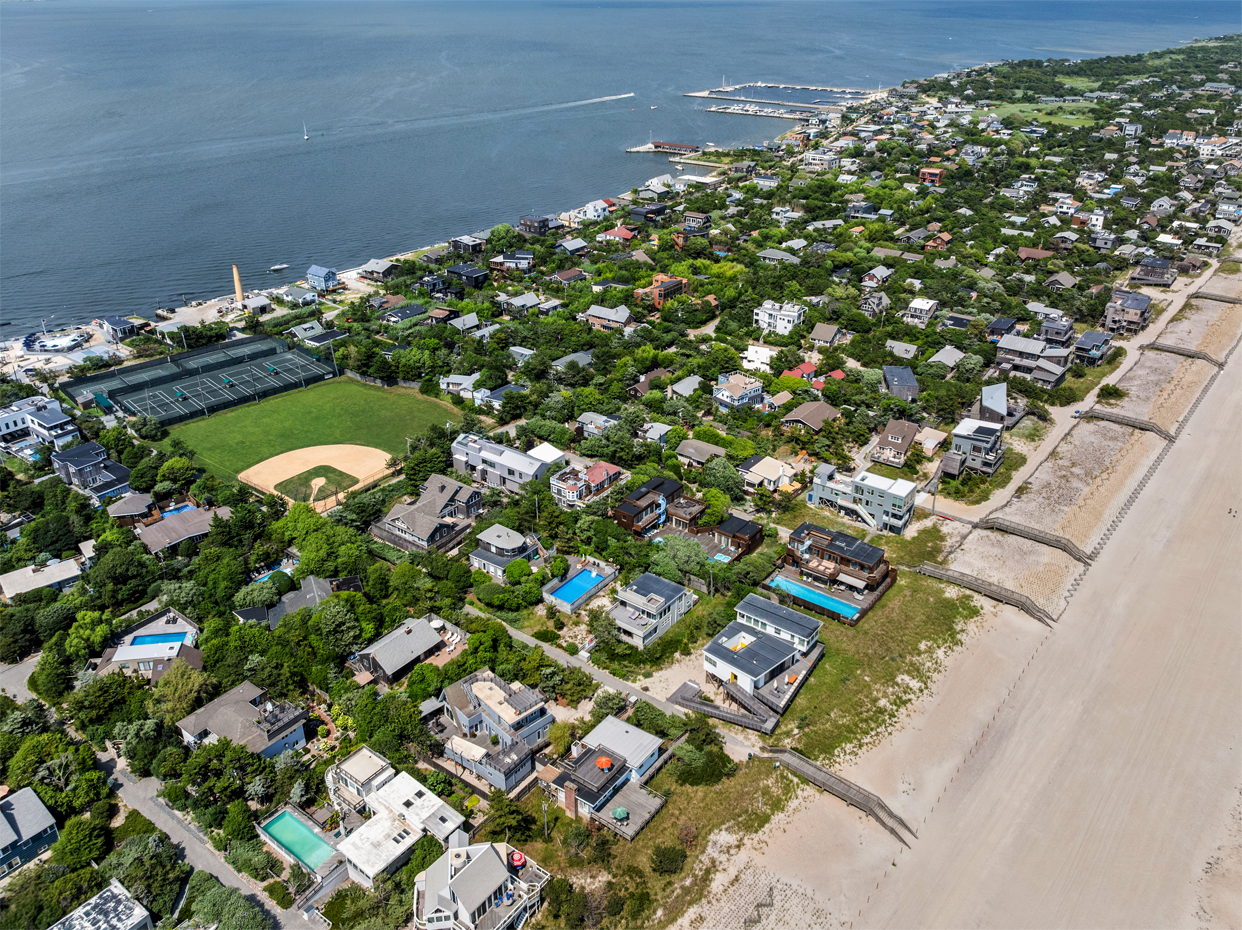
Fire Island Real Estate Market Update: 2025 Trends
The Fire Island Market in 2025: Prices Keep Climbing, But the Playing Field Has Shifted
By: Abigail Mago
Licensed Broker, Fire Island Sales & Rentals | Market Intelligence | May 2026
If you've been watching the Fire Island real estate market over the past few years, you may have noticed something that can feel almost contradictory: fewer homes are selling, yet prices continue to rise. The 2025 data confirms that paradox in striking fashion — and understanding why it's happening is essential whether you're thinking about buying or selling on the island this year.
Here's a deep dive into what the numbers are telling us, how 2025 compared to 2024, and what the early 2026 data signals for the season ahead.
The Big Picture: 2025 vs. 2024
Total sales dropped sharply — again. In 2025, Fire Island recorded 61 residential transactions, down from 89 in 2024 — a 31% year-over-year decline. To put that in perspective, the island saw 236 sales at the height of the COVID boom in 2021. We are now operating at roughly one-quarter of that pace.
But here's the part that surprises most people: average sale prices kept rising. The island-wide average sale price reached $1,428,840 in 2025, up approximately 2.6% from $1,392,814 in 2024. That continues a streak of unbroken annual appreciation that stretches all the way back to 2019, when the average stood at just $820,381. In the last six years, average Fire Island home prices have risen more than 74%.
The median sale price — often a more reliable barometer of where the market truly stands, since it isn't skewed by a handful of high-dollar outliers — tells a consistent but more measured story. The island-wide median reached $1,250,000 in 2025, up from $1,170,000 in 2024 — a 6.8% increase that actually outpaced the rise in the average. That's a meaningful signal: it suggests price strength is broadening across the market, not just being driven by a few exceptional transactions at the top end. For context, the 2025 median is up 52% from the pre-pandemic 2019 median of $800,000 — still a remarkable run, but notably more restrained than the 74% gain the average achieved.
What does this mean? It means the market is not correcting — it is compressing. Sellers who don't have to move are choosing not to, keeping inventory at historically low levels. The buyers who are transacting are typically well-capitalized, motivated, and willing to pay a fair price for the right property. The result is a smaller pool of transactions at higher price points.
Where the Sales Happened: A Town-by-Town Look
Not every community performed the same way in 2025. Here's how the major communities shook out:
Ocean Beach remained the most active community on the island, recording 22 sales in 2025. As the commercial center of Fire Island, Ocean Beach has loong been the most Its relatively broad price range — from modest cottages to premium luxury homes — gives it more buyer depth than anywhere else on Fire Island, making it a reliable bellwether for the overall market. The median sale price in Ocean Beach held steady at $1,275,000 in 2025, modestly increasing from 2024's $1,200,000 median, while the average jumped to $1,476,307 — a wide gap that reflects at least one or two high-end transactions pulling the average up considerably.
Ocean Bay Park recorded 6 sales, with the median reaching $1,508,750 — up meaningfully from $1,400,000 in 2024 — reflecting the community's continued shift upmarket as newer and larger construction has come to dominate the transaction mix.
Seaview had 4 sales but punched well above its weight in dollar volume, driven by several high-value transactions including a significant oceanfront sale. Seaview's median came in at $1,452,500 in 2025, essentially in line with 2024's $1,450,000 — a stabilization after the extraordinary $2,590,000 median recorded in 2023. The narrowing gap between Seaview's median and average in 2025 (median: $1.45M, average: $2.14M) signals that a small number of outsized oceanfront deals continue to drive the community's headline average skyward; the median is the more honest read on where most Seaview transactions are clearing.
Fire Island Pines recorded 6 sales in 2025 — a modest recovery from the remarkable low of just 2 sales in 2024, but still far below the Pines' historical pace of 25–47 transactions per year between 2017 and 2022. The 2025 median of $1,600,000 marked a sharp rebound from 2024's depressed $608,125 median (which was based on just 2 transactions and is not statistically reliable), and from the $908,000 median in 2023. The Pines luxury market remains the most constrained, but the price level on the deals that did close in 2025 suggests buyers and sellers are finding each other at the upper end of the market when properties are priced appropriately.
Fair Harbor was notably quiet with just 2 sales in 2025 — down sharply from 14 in 2024 — at a median of $837,500, which represents a pullback from 2024's $995,000 median. Cherry Grove saw 3 transactions at a 2025 median of $799,000, slightly above its 2023 median of $720,000. Kismet recorded 2 sales at a median of $1,175,000, continuing a gradual upward drift from earlier years.
Lonelyville quietly emerged as a surprise bright spot, logging 6 sales at a median of $1,180,000 — more volume than many larger communities and a price level that reflects the growing appetite for this historically under the radar enclave.
Why Is Volume Down But Prices Up?
This is the question every buyer and seller is asking, and the answer comes down to one word: inventory.
When the pandemic drove a tsunami of buying activity in 2020 and 2021, buyers absorbed a meaningful chunk of the available housing stock. Many of those new owners have no compelling reason to sell — they're using the properties, renting them profitably, or simply holding as investment assets.
At the same time, higher interest rates have reduced affordability at the margin, pushing some would-be buyers to the sidelines and slowing the velocity of transactions. But Fire Island buyers skew more toward cash purchases, so the rate environment has had a more muted effect here than in most mainland markets.
The net effect: supply is thin, qualified demand still exists, and prices have nowhere to go but up — albeit more slowly than during the 2020–2022 frenzy.
A Closer Look at Median Prices: The Cleaner Signal
One of the most useful lenses for understanding this market — and one that often gets overshadowed by headline average prices — is the median sale price. Because the median simply identifies the midpoint of all transactions (half sold above, half below), it neutralizes the distorting effect of the occasional $5 million oceanfront or $500,000 distressed sale that can pull an average in misleading directions.
Looking at the island-wide median over time tells a story that is still one of strong appreciation, but with more nuance than the average alone conveys:
| Year | Median Price | Average Price | Median as % of Average |
| 2019 | $800,000 | $820,381 | 97.5% |
| 2020 | $825,000 | $955,834 | 86.3% |
| 2021 | $896,000 | $1,130,567 | 79.3% |
| 2022 | $995,050 | $1,215,924 | 81.8% |
| 2023 | $1,107,000 | $1,317,949 | 84.0% |
| 2024 | $1,170,000 | $1,392,814 | 84.0% |
| 2025 | $1,250,000 | $1,421,117 | 88.0% |
A few things stand out here. First, the gap between median and average widened dramatically in 2020 and 2021 — the median-to-average ratio fell from 97.5% in 2019 to 79.3% in 2021. This tells us that the pandemic buying frenzy was disproportionately concentrated at the high end: luxury buyers transacted aggressively, pulling the average up far faster than the middle of the market was actually moving. The "typical" Fire Island buyer in 2021 was paying $896,000 — not the $1.13 million average suggests.
Second, and importantly, the median-to-average ratio has been recovering since 2021, reaching 88% in 2025. This is a sign of market normalization: the high-end outlier effect is fading, and price appreciation in 2025 was more broadly distributed across price tiers than it was at the peak.
What Sellers Need to Know
The data offers an important nuance for anyone considering selling in 2026: pricing discipline matters more than ever.
With transaction volume this low, overpriced listings sit. Buyers are sophisticated and well-researched — they know what comparable properties have traded for. In a market with 61 annual sales, there are very few "greater fools." Properties that are priced at or slightly below market expectation are selling; those priced to 2021 peaks are not.
The good news for sellers is that values genuinely have held. You don't need to give your property away. But you do need to be realistic about where the market is today versus where it was three years ago.
Presentation also matters enormously in a low-volume market. When a buyer has fewer choices, they scrutinize each one more carefully. Homes that show well and are turnkey command premiums; those that need work are being discounted aggressively or simply not selling if not priced realistically with respect to their condition.
What Buyers Need to Know
For buyers, the current environment offers something that was nearly impossible to find in 2020 and 2021: time to think.
The frenetic bidding wars and waived contingencies that defined the pandemic years have largely dissipated. In most cases, you can take a breath, do your due diligence, and negotiate. That said, "negotiate" does not mean "lowball." Well-priced properties in desirable locations, or with special features like waterfrontage or water view and oversized parcels — still are met with strong demand, and frequently with multiple offers.
The buyers who are finding success right now are those who've done their homework on specific properties and come in with realistic price expectations and flexible timelines. As the Summer season is fast approaching, sellers tend to become less motivated to close quickly and more likely to request closings after Labor Day, so as to enjoy one last Summer in paradise and/or keep the season’s rental income.
Given the low inventory environment, we have been doing a larger proportion of our deals off the market. In many cases there are no on-market options available that meet a buyer’s criteria, so we approach owners whose properties may be a fit on the buyer’s behalf and have been able to put together a number of deals that way. If you’re interested in buying but nothing available meets your criteria, let us know what you’re looking for and we will do our best to find it for you.
One more thing for buyers to keep in mind: the longer-term price trend is your friend if you buy and hold. The 74% appreciation since 2019 is not a fluke — it reflects genuine, durable demand for a finite, irreplaceable product. There is only one Fire Island and there are only so many homes here.
Early 2026: What the Data Is Telling Us
Through late March 2026, the island has recorded 9 sales, spread across Ocean Beach (2), Fire Island Pines (2), Ocean Bay Park (2), Cherry Grove (2), and Seaview (1). There may be additional sales that closed during this period but were not yet recorded so are not reflected in the data set. The average price on those early 2026 transactions is tracking at approximately $1,479,000 — continuing the upward trajectory in the average. The first quarter 2026’s median sale price is $975,000. Early-season sales on Fire Island have historically skewed toward deals negotiated over the winter — often involving more motivated sellers — so the median tends to drift down before the summer selling season normalizes it. We'd expect the full-year 2026 median to land in the $1.3M range as deal flow picks up in line with seasonal norms.
In evaluating the 2026 market, there are a few reasons for cautious optimism:
Interest rates have begun to ease. As borrowing costs come down — even modestly — some buyers who were sidelined re-enter the conversation. Fire Island buyers may be cash-heavy, but rate movements still affect the broader wealth environment they operate in.
Current Tax policy offers significant incentives for short term rental owners. We are seeing an uptick in activity of buyers looking to purchase Fire Island properties to use as short term rentals in order to offset W2 income via the short term rental tax loophole. By commissioning a cost segregation study, buyers can take advantage of 100% bonus depreciation, resulting in tremendous and immediate potential tax savings on top of the ordinary cash flow of the investment. Fire Island’s proximity and robust short term rental market make it an ideal location for Long Island and New York City high income earners to deploy this strategy. I believe this trend will continue to drive a considerable amount of buyer activity in the market going forward.
Seller motivation may gradually increase. As the pandemic-era buying cohort moves through life changes — kids growing up, relocations, circumstances evolving — more of those 2020–2021 purchasers may choose to monetize their gains. Even a modest uptick in listings would meaningfully shift the market. At the time of this writing, there are only 48 active listings island wide, so those considering listing their homes will benefit from limited competition in the current environment.
The seasonal factor is real. Fire Island's market is heavily back-half loaded. Historically, Q3 and Q4 (July through December) account for the majority of annual transactions.
The most honest forecast for 2026 is this: another relatively quiet year in terms of volume, with prices likely to continue to edge higher. If anything resembling a normal spring and summer listing season materializes, we could see that volume estimate revised upward. If inventory remains as constrained as it has been, we’re unlikely to see a dramatic increase in activity.
The Bottom Line
Fire Island real estate in 2025 and into 2026 is a market defined by scarcity, resilience, and careful navigation. Prices have never been higher. Transaction volume has rarely been lower. That combination creates both opportunity and complexity for anyone on either side of a deal.
The communities, the housing stock, and the lifestyle that make Fire Island irreplaceable haven't changed. What has changed is the pace at which ownership has been turning over — and for a market this unique, that may simply be the new normal.
Whether you're thinking about making your first Fire Island purchase, moving up within the island, or considering whether now is the right time to sell, we're here to help you read the data and make the move that's right for you.
Abigail Mago, Licensed Broker
(516) 510-3207
abigail@fisr.com
Have questions about the current market or a specific community? Reach out to the team at Fire Island Sales & Rentals — we track every transaction on the island and are happy to walk you through the numbers in detail.
Contact Us | Search Listings | Market Reports Archive
Fire Island Sales & Rentals proprietary transaction database utilizes data sourced from Public records and the Multiple Listing Service. Statistics reflect arms-length residential sales and exclude commercial properties, vacant land, and partial interest transfers. 2026 data is preliminary through March 2026.